Montclair, the surrounding Essex County towns and Clifton in Passaic County
Mold Removal in Montclair and Essex County
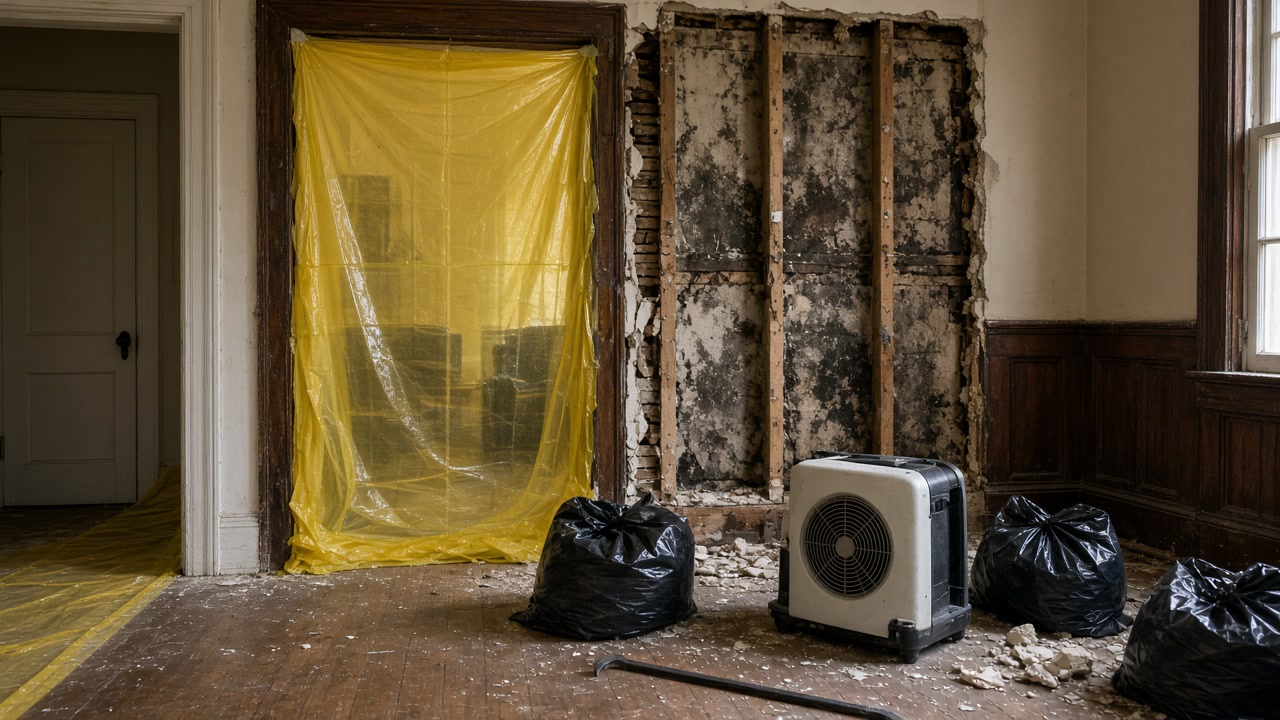
Take out the material the mold has grown into, under containment, and put the room back with the original plaster, trim and stonework treated as worth saving, all priced against a scope somebody else wrote.
Mold Removal quote
Four answers cover most of it: which room, what the wall is built of, where the water came in, and whether a scope exists yet. With those we can normally tell you whether this is a contract or an afternoon.
Would you rather talk it through? Call (315) 640-3590, answered 24/7.
$100 off your first job
Credited by us on your first booked job.
- One credit per customer per property, on your first booked job.
- Valid through December 31, 2026.
Mention this offer when you book. Full terms.
What is taken out, what is saved, and who signs it off
A removal takes out the material the mold has grown into, cleans what stays, dries the structure to a reading and leaves the room ready to be put back. In this township the second half of that sentence is the expensive half. Close to six in ten Montclair homes went up in 1939 or earlier, so what comes off the wall is often plaster on lath with original trim around it and a stone or early poured foundation behind it, and none of that goes back the way a sheet of drywall does. So the scope is settled first: what is being opened, how far the containment runs, what is coming off carefully and going back, and what is being replaced. Then the work runs from the water backwards, because a wall opened while water is still arriving is a wall that gets opened twice. And it is arranged with a contractor who did not write that scope. New Jersey licenses neither half of this trade, so nothing in state law keeps the company that finds the work apart from the company that sells it, and on a slope where the water and the damage are frequently on different walls, that gap is not academic.
- Containment and negative air on the work area, so dust from a prewar basement does not travel through the rest of the house
- Removal of material the water has ruined: drywall, batt insulation, framing where it has gone soft, carpet and pad, ceiling tiles and boxed storage
- HEPA vacuuming and detail cleaning of what stays: joists, subfloor, the back of original plaster, and stone or block wall faces
- Careful opening of plaster and lath, with trim and moldings taken off, labeled and reinstated rather than replaced with a modern profile
- Crawl space work under additions, porches and older rear sections, including access and ground cover
- Attic work where the moisture came from inside the house: sheathing cleaned, wet insulation removed, soffit ventilation cleared and bath fans ducted to the outside
- Drying masonry, subfloor and framing to a measured reading before anything is closed up
- Coordinating the repair that stops the water with the trade that owns it: grading and downspouts, a perimeter drain and sump, a roof, or a plumber on a supply line
- Rebuilding in materials that suit a below grade wall on this slope, and leaving inspection access where it will be worth having
- A closing check written by whoever wrote the scope, not by whoever cut the wall
What moves the price on a house built in 1938
Nothing is cut until the scope is settled, and what settles it is the make-up of the wall, how far into the framing the water went, and which of your town's permissions the job turns out to touch.
What the wall is actually made of
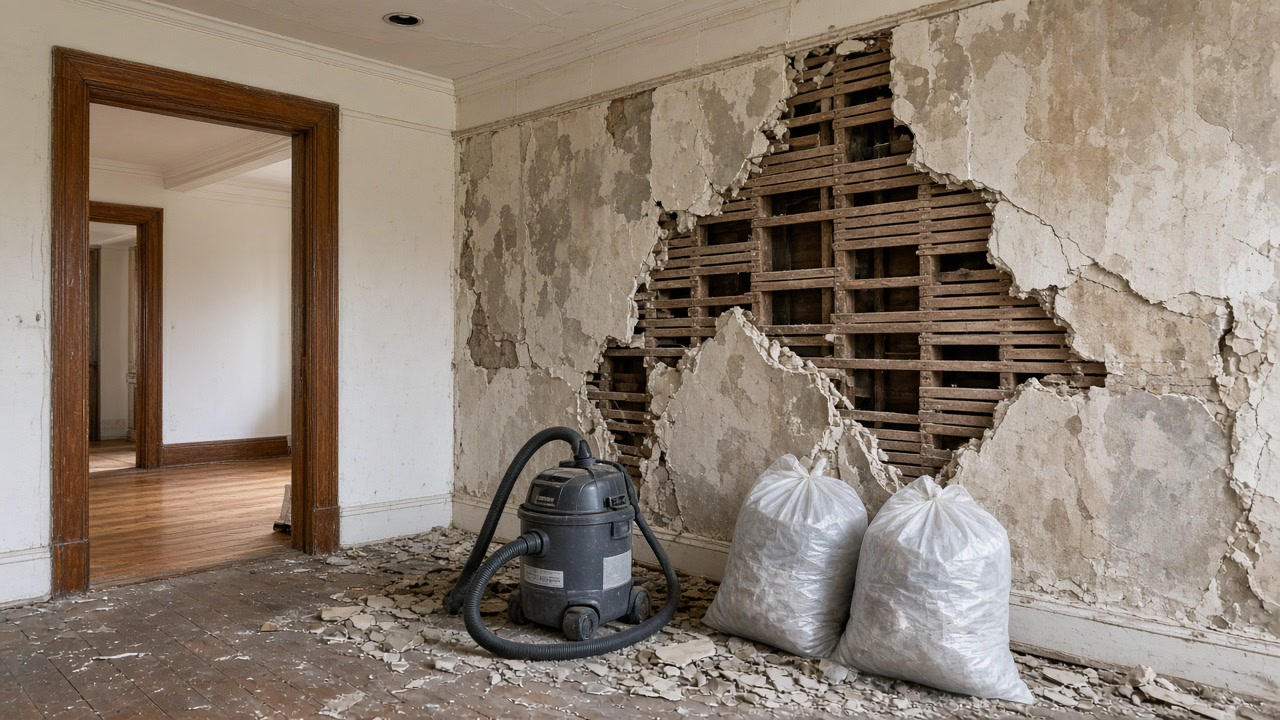
The median Montclair home was finished in 1938. Plaster on lath comes off slower than drywall, the trim around it is a profile no lumberyard stocks, and rubble stone does not clean like a smooth block. A price built on a modern finished basement and a price built on a prewar one are different numbers for the same square footage, which is why an estimate over the phone means very little here.
How much of the framing the water reached
The state health department's own booklet points out that drywall, ceiling tiles and wood framing contain cellulose for mold to grow on, and that as it grows it can begin to break down the studs and joists of a building. Surface cleaning and structural repair are different trades and different budgets, and only opening the cavity tells you which one you have bought.
Whether the water has been stopped, and whether it can be
The township states that most of its flood zone properties sit behind undersized road culverts and encroachments built for the town of fifty years ago, and that peak flows have risen with development since. Nothing you do to your own house changes an upstream culvert. Where that is the situation, the work is designed to manage water at your own boundary and inside the wall, and the material specification changes accordingly.
What else is inside a prewar wall
With the median build year at 1938 and just under six in ten homes predating 1940, asbestos and lead are live questions in this housing stock before a saw goes into anything. They are separately handled disciplines with their own rules, they are cheaper to establish than to discover halfway through, and they belong in the sequence before demolition rather than in a change order after it.
Which town is issuing the permits
Every municipality here enforces the state construction code through its own agency under its own chapter, Montclair under Chapter 121 with its own construction official. In Montclair alone a basement job can touch three separate permissions: construction, flood damage prevention under Chapter 161 with a floodplain administrator, and stormwater under Chapter 295. A contractor who mentions only the building permit has checked one of the three.
Whether any of the work goes outside onto the slope
Montclair has a steep slopes chapter aimed at erosion, soil slippage, runoff and flooding from construction on sloping ground. Regrading or excavating a drainage structure against an uphill foundation can land inside that ordinance instead of being a landscaping afternoon, so the question gets asked before a machine is booked, not after it arrives.
Whether the property sits in a mapped flood hazard area
Around 810 Montclair parcels lie in one or more flood zones, and the county plan records that the state Inland Flood Protection Rule now measures new construction and redevelopment against the New Jersey Design Flood Elevation. That can change what is allowed to go back into a lower level, so on a mapped property the floodplain administrator is consulted before materials are ordered.
Who is living in it while the work runs
Only about half of Montclair's housing is single family detached and roughly 43 percent of occupied homes are rented, so a basement is often under somebody's apartment or is somebody's apartment. Access, working hours, notice and who is authorizing the spend all have to be settled in writing before containment goes up, because that is the point at which a household's routine changes.
Find out whether the wall has to come out at all
The side of the house the water arrives on settles that question. Send us the room and which way the ground falls outside it, and we will say which of the three jobs you are looking at. No obligation either way.
Water first, then walls: the order this runs in
Start from a scope, not from an estimate
One page: which areas, what quantities, which method against each, and how much containment. Three contractors pricing the same page are giving you three prices. Three contractors each writing their own scope are giving you three different jobs, and the cheapest is usually the smallest.
Deal with the water before anything is opened
On this slope that can mean a downspout and a grade, a perimeter drain and a sump, or a plumber. A wall opened while water is still arriving is a wall that will be opened again, and the second opening is never covered by the first price.
Establish what else is in the wall
In a house built before 1940, asbestos and lead get ruled in or out before demolition rather than during it. This is the cheapest step in the sequence and the most expensive one to skip.
Set containment and air control
Sheeted barriers, negative pressure, filtration and protected routes in and out, so that opening a 1938 basement does not redistribute it through the floors above. In an occupied two family house this step is also what makes the work tolerable to live over.
Open, remove, and keep what is worth keeping
Trim and moldings off in one piece where they will come, labeled, and set aside. Plaster cut to a line that can be patched rather than to wherever the crowbar went. Ruined material bagged out under containment. What comes out is photographed as it goes, because that is the only record of it that will ever exist.
Clean what stays, then dry it to a number
HEPA vacuuming and detail cleaning of joists, subfloor and masonry, then drying to a measured reading rather than to how a surface feels. Stone and old mortar hold water long after framing feels dry, and closing a wall over a wet one puts you back at the start next spring.
Fix the humidity the finished room will live in
The EPA asks for indoor relative humidity below 60 percent, and a basement on this slope will not hold that through a local August without help. A rebuild with no plan for summer air is a rebuild that grows the same thing again, and the plan is normally a dehumidifier and a drain, not a machine.
Close it out and keep the file
An independent check against the written scope, and a folder with the readings, the photographs and the invoices in it. In New Jersey a seller now has to answer, in writing, whether the property has had water seepage or pooled water from heavy rainfall and how many times, so this folder is the difference between answering that question with a record and answering it with a shrug.
Mold Removal work we have arranged
What mold removal looks like
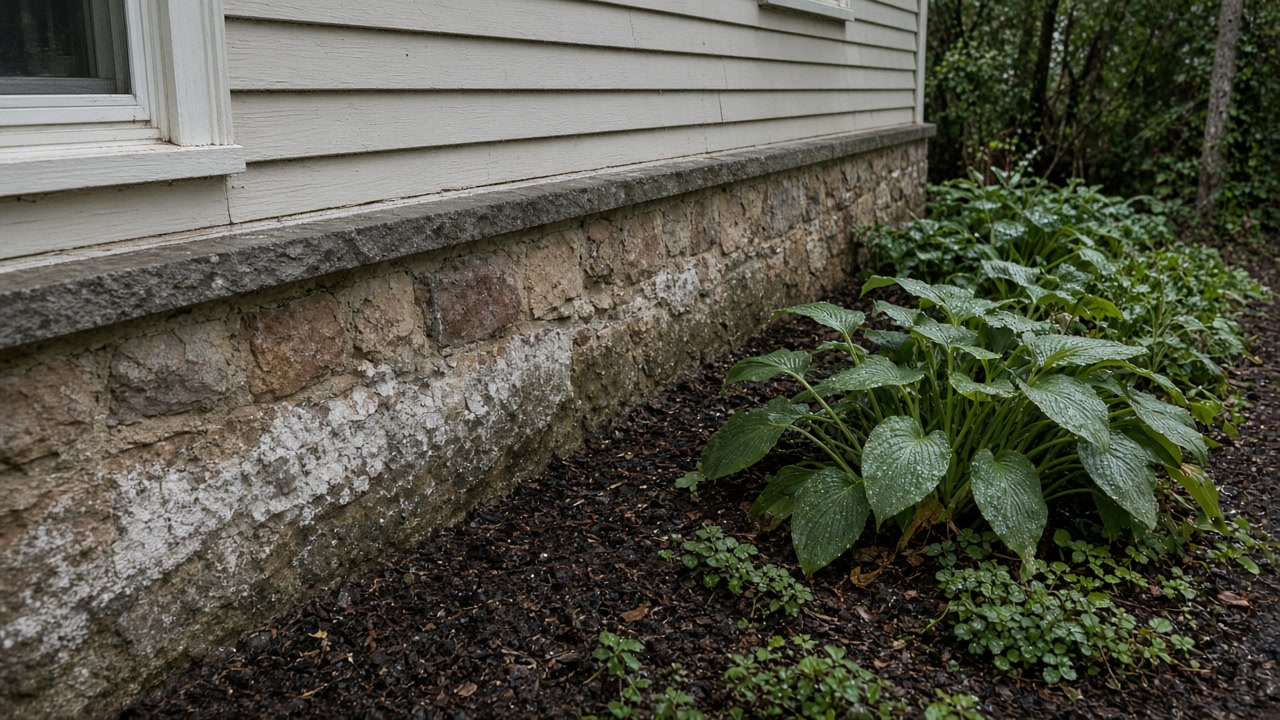
What a removal leaves to others, and when you do not need one
When you may not need this at all
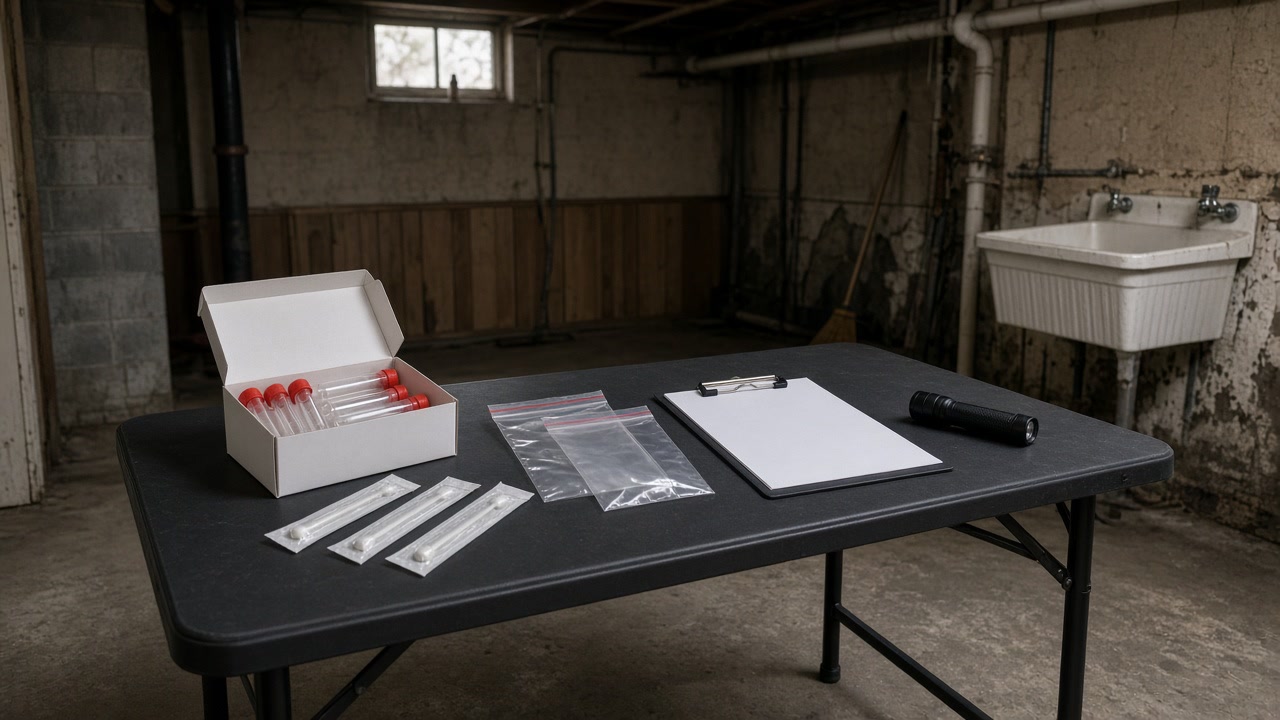
- A small patch on painted masonry or another hard surface in an unfinished basement, where the water has already been dealt with, is normally a bucket, a brush and an afternoon. No New Jersey license governs that work, so there is nothing to stop you doing it yourself.
- If the room is only musty in high summer and settles down in the fall, removing drywall will not fix it. That is condensation on a cold wall, and no amount of demolition changes a dew point. Start with a meter and a dehumidifier.
- If water is still coming in, or the room went wet within the last forty eight hours, this is not your page yet. Drying inside the first 24 to 48 hours is what decides how much has to come out at all, and every hour spent collecting quotes is an hour off that clock.
- If you rent, this is not yours to authorize. Put the condition to the landlord in writing, keep a copy, and ask the municipal property maintenance office about the leak or the plumbing fault behind it, which is the part a town can act on.
- If nobody has measured the area or said where the water comes from, you are not comparing prices yet, you are comparing guesses. Get the scope written first, even if somebody else writes it.
What is out of scope
- The survey that scopes the job and the check that closes it. Both deliberately sit with another firm, and that split is what this site is for.
- The permanent water repair outside the building: regrading, a perimeter drain, a retaining wall, a roof or a plumbing repair. Arranged where we can, but different trades, different permits and the thing that decides whether you do any of this twice.
- Anything in the street, the storm drain or a culvert running off your property. The township says its own culverts are undersized for the town as it now stands, and that is a municipal matter rather than a contractor's.
- Asbestos and lead abatement. Separately handled disciplines, and in this housing stock they come before demolition.
- Insurance claim handling. The work is documented as it goes; what an adjuster does with that is between you and the insurer.
- Any opinion on health, symptoms or diagnosis.
- Any promise that it cannot come back. Growth follows moisture. Keep the water out and the wall stays clean; let it return and so does everything else.
Removals arranged around Montclair and Essex County
What owners ask before a removal starts
Will the plaster and the original trim survive it?
That depends almost entirely on whether it was planned for before the first cut. Trim taken off in one piece, labeled and reinstated looks like the house. Trim pried off in a hurry looks like a repair forever, and in a township where the median home dates to 1938 that difference shows in the room and in the sale. Say at the scoping stage that the finishes matter to you, and the sequence and the day count get written around them.
Do I need a permit just to remove mold?
The removal itself is not usually the permitted part. What surrounds it often is. Every town here enforces the construction code through its own agency under its own chapter, and in Montclair a basement job can touch construction under Chapter 121, flood damage prevention under Chapter 161 and stormwater under Chapter 295, with different officials on each. Ask which of the three your job touches before work starts, because the answer is not the same in the next town over.
Can the company that inspected also do the removal?
New Jersey permits it and most of this market works that way. We do not arrange it that way. The scope is written by one company and the work is done by another, so the page the job is priced against was not written by the business being paid to cut the wall. That is a choice, not a legal requirement, and it is worth asking any contractor how they handle it.
What does a removal cost?
No honest number exists before somebody has measured the room, and anyone who gives you one over the phone is quoting a different house. What moves it is the measured area, what the finish is made of, how much framing the water reached, how much containment the occupied parts of the house require, and whether the repair that stops the water is inside this job or a separate one. A written scope is what turns those five variables into comparable prices.
It only gets wet in the big storms. Do I really have to open the wall?
Frequently yes, and the reason is the finish rather than the storm. Almost half the Montclair flood claims that record a basement type were on finished ones, and a stud wall with batt insulation holds water against the masonry and hides it while it works. Federal guidance puts the growth on the back of the drywall, not the front. A wall that dries out in view and stays wet in the cavity looks like a wall that recovered.
Is there a state register I can look a mold contractor up in?
Not for mold. Senate Bill 3275, introduced in February 2026, would fold mold inspection and remediation contractors into the existing home improvement and home elevation contractor law, and it has not been enacted. So the registration to ask for today is the general home improvement contractor one, and the things you can check yourself are insurance, a written scope, a measured area and references on houses of the same age as yours.
Tell us what the water reached
Enough to settle the order of work, and who has to sign off before a saw comes into the house.